|
CUSTOMER CARE & BILLING SYSTEM |
|
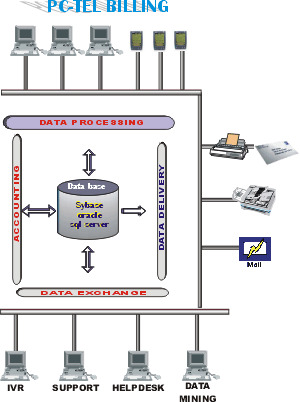
1. Cost accounting system for telecom, electric power supply, water supply and digital TV applications. The aim of the cost accounting system is to register, charge, print and provide statistical info regarding the voice and data network, the end users and system administrators. The system registers and estimates cost of calls and network usage in real time, while it provides any kind of reports using the collected data. The system can collect info and data from many different network points and if it necessary to keep records. Generally speaking, the system is able to collect and estimate cost of data which come from multiple sources regarding different services.
1.1 System functions 1.1.1 Administration of system users This function provides the management of the database in which all the legal users of the system are registered. The info needed in order to recognize the users is name, address, telephone and a characteristic pin code. The pin code is unique for every user. Therefore there is the possibility to create and manage user groups. These groups include more than one user. Grouping users, enables support of dealers since they are also a group of users. Dealers are organizations or ancillaries which supervise more than on user. For every user we can determine some of its characteristics (e.g. info about charging) either independently or from it’s group. The necessary info for each user are the following:
Management of users allows the import, modification and erasure of them. There is the possibility for every user to estimate cost of more than one service in the same system and provide analytical bill for each service. The info stored for each user team is the following:
Additionally it is easy to correlate users with user groups so that they share information based on the team they belong and receive common service packets. Example Assume there are four users A1, A2, A3, A4. The first three belong in dealer 1, while the fourth is independent. The users management function may create these users and the dealer1 and correlate A1, A2, A3 with dealer1. Thus, the administrator may activate access to voice telephony, internet, even satellite TV program. In a different user group the administrator may activate only voice telephony etc.
1.1.2 Registration of events The aim of this function is the communication of the system with the centers that participate in the distribution services network and the info collection of the services the users take advantage of, in real time. The communication of cost estimation system is in real time and the appropriate interface is used for the registration. Interface between terminals may be of different type from terminal to terminal in the network (serial, ASCII file, database, infrared etc). Furthermore the registration format may be of different type as well. The system automatically recognizes and estimates cost for the appropriate service utilized by user. The received data is stored and after the cost estimation it is registered in the database for future use. In case of useless data, it is stored in a different database for evaluation and further action. Please mention that many times useless data coming from imperfect terminals may provide very useful information regarding the repairing process of the terminal. In order for the system to operate properly the following info must be sent: · Transmission point · Event code · User pin code · User phone number · Digital center input line identification · Digital center output line identification · Date and time of event · Outgoing call phone number · Duration of conversation/event/amount of info/
1.1.3 Events cost Events cost estimation is possible using the registration of a call that is recorded. The system is aware of the prices of different services and contracts and calculates the final cost for each service using an algorithm. The info required for the system in order to calculate the cost using the algorithm is the following:
Cost estimation
1.1.4 Reports and printouts The cost estimation system provides reports relevant to:
1.1.4.1 Statistics Detailed statistical info may be appeared in lists or graphical representations. Statistical info may be provided from predetermined lists or graphs and from lists and graphs the administrator may create. 1.1.4.2 Customer accounts The main customer account consists of: the first page which is the invoice and includes company info, customer’s info, financial etc and the total charge for the relevant interval of time. Next pages present analytical description of charge per service used and statistical info per service and time compared to previous period. 1.1.4.3 Commercial department The aim of the commercial department is the determination of invoice policy and management of system subscribers and dealers. For this purpose:
1.1.4.4 Dealers The system manages dealer’s customers and provides statistical info and printouts for their information. Also, provides electronic files for further evaluation from dealers.
1.1.4.5 Service providers A significant part of the cost estimation system is the management of service providers. It is necessary for the financial unit to be able to control the service cost in order to estimate properly by its turn the charge for customers and dealers. For this purpose, a particular subsystem enables the management of providers file in order to control and charge the services and to determine properly the invoice policy even for a single customer. The system may provide reports per provider and services and even predict using printouts, statistics and electronic files for processing by other systems.
1.1.4.6 Loyalties system The ability of sending data to the loyalty system is also significant, since it enables the marketing department to collect the necessary information regarding market needs.
1.1.4.7 Subsystems Cost estimation system is able to send and receive information from other systems in order to serve properly the financial unit where it is installed. For example, CRM applications, commercial/logistics applications of third manufacturers etc.
1.1.5 Additional abilities Furthermore:
Cost estimation system notifies the logistics department in case a customer has an outstanding bill. In this case customer’s bill will include the previous as well as the current charges.
|